Travelling Birds Sigur Ros

April 10th, 2008

…as played by Kronos Quartet.
This one just seemed to fit this moment of this day.


Flugufrelsarinn by Sigur Ros, played by Kronos Quartet. Video credit thanks to mead2000!

Wayne “Frosty Freeze” Frost, a hip-hop pioneer whose acrobatic performance with the legendary Rock Steady Crew in the 1983 movie “Flashdance” helped set off a worldwide breakdancing craze, has died. He was 44. Breakdancing emerged from the Bronx and Harlem in the early 1970s, part of the hip-hop culture that also included graffiti, MCing or rapping, and disc jockeys scratching and mixing vinyl records on turntables. Frost was known for many things including his energetic style, intricate choreography and fearless moves including back flips & head spins. One was even dubbed the “Suicide.” Frost got his start back in 1978 with the Bronx-based Rock City Crew. In 1981, he became part of the Rock Steady Crew, joining such acclaimed breakdancers as Ken Swift and Lil Crazy Legs. Frost toured the world with the Rock Steady Crew and other hip-hop artists, including Fab 5 Freddy, Futura 2000 and Kool Lady Blue. Graffiti artist and close friend Zulu King Slone, who knew Frost for 15 years, said he was “like a walking hip-hop culture encyclopedia.”
waynefreeze.jpg


Young Stephen and Ziggy from the Reggae Sunsplash, 1981 - A Tribute To Bob Marley!

Be Blessed.

Cuban bassist & composer Israel “Cachao” Lopez, who is credited with pioneering the mambo style of music, died Saturday. He was 89. Known simply as Cachao, the Grammy-winning musician left communist Cuba and came to the United States in the early 1960s. He continued to perform into his late 80s, including a performance after the death of trombonist Generoso Jimenez in September 2007. Cachao was born in Havana in 1918 to a family of musicians. A classically trained bassist, he began performing with the Havana symphony orchestra as a teenager, working under the baton of visiting guest conductors, such as Herbert von Karajan, Igor Stravinsky and Heitor Villa-Lobos, during his nearly 30-year career with the orchestra. He also wrote hundreds of songs in Cuba for bands & orchestras, many based on the classic Cuban music style known as son. He and his late brother, multi-instrumentalist Orestes Lopez, created the mambo in the late 1930s. The mambo emerged from their improvisational work with the danzon, an elegant musical style that lends itself to slow dancing. The mambo was embraced early on and Cuban composers & jazz musicians have tweaked it over the years. It also influenced the development of salsa music. In the 1950s, Cachao and his friends began popularizing the descarga (”discharge” in Spanish), a raucous jam session incorporating elements of jazz & Afro-Cuban musical approaches. Cachao left Cuba in 1962, relocating first to Spain and soon afterward to New York, where he was hired to perform at the Palladium nightclub with the leading Latin bands. In the United States, he collaborated with such Latin music stars as Tito Puente, Tito Rodrigues, Machito, Chico O’Farrill, Eddie Palmieri and Gloria Estefan. In 2006, Cachao was honored at two Jazz at Lincoln Center concerts with the Afro-Latin Jazz Orchestra paying tribute to the Latin bass tradition. Cachao also led a mambo all-star band at a JVC Jazz Festival program at Carnegie Hall that year.

cachao.jpg

My Burning Ears

March 7th, 2008

so much new music so little time. I thought about a music share, just letting your eyes see what my ears are taking in and I certainly hope to get as much of these artists and these albums on the airwaves as soon as possible. From my sandbox to yours:

Huong Thanh & Nguyen Le- Fragile Beauty
Marcus Miller- Marcus
Four Finger Five
Putumayo presents Euro Groove
the Sparkiovoggel- sample platter
Phil Anastasia- the Outfit Movement Vol.1
Matana Roberts- the Chicago Project
Dengue Fever- Venus on Earth
Uri Caine- the Classical Variations
Ethiopiques= #23
Lee “Scratch” Perry- Chicken Scratch
Rob Fried- Wind Song
Sol Creech Band- Freedom
Brothers of the Baladi- Just do What’s Right
Elliott Sharps’s Terraplane- Forgery
In the Name of Love- Africa Celebrates U2
Eric Sardinas & Big Motor
Bob Brozman Orchestra- Lumiere
Chet Atkins & Les Paul- Chester & Lester
Quartet San Francisco- Whirled Chamber Music
Giant Panda Guerilla Dub Squad- Slow Down
RAQ- Live
Travis Sullivan’s Bjorkestra- Enjoy!
I’m not There- Original Soundtrack
Out to Lunch- Excuse me While I do the Boogaloo
Edgar Gabriel’s Stringfusion- Not Radio Material

listeningeye.jpg

R I P Jeff Healy

March 4th, 2008

Canadian rocker Jeff Healy, who played his guitar flat on his lap, has passed away. Healy, 41, died in a Toronto hospital of a rare cancer - retino blastoma - that he had fought since birth and which claimed his eyesight at the age of one. “Visually, Jeff was an intriguing player to watch, because he played guitar - by any conventional standard - all wrong, with it flat across his lap,” his publicist Richard Flohil told broadcaster CTV. “But he was a remarkable, a virtuoso player.” Don’t forget folks, he was also blind. The Jeff Healy Band’s 1988 Grammy-nominated album See the Light, which included the hit “Angel Eyes”, sold more than 1 million copies in the United States. He worked with blues legends BB King and Stevie Ray Vaughn, and recorded with George Harrison, Mark Knopfler and Jimmy Rogers. Also unfortunate, at the time of his death, he was about to release his first rock-blues album in eight years - Mess of Blues.

jeffhealy.jpg
Norman Jeff Healy March 25, 1966 – March 2, 2008

Tomorrow on WORT-FM

March 3rd, 2008

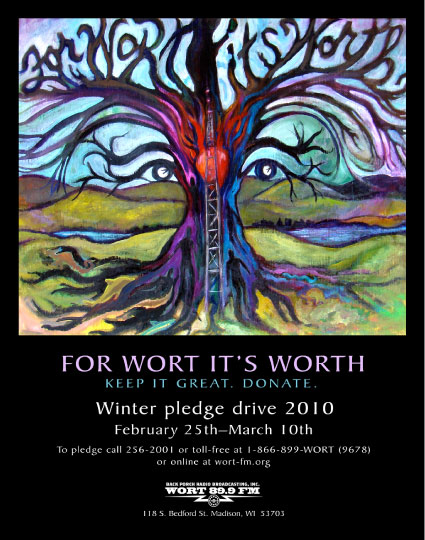
I have been invited to do a fill-in show on WORT-FM for the programThe Big Beat Tuesday 2–5pmCST, which features hard bop with the usual host Mr. Michael Kwas. It is also a chance for you to pleade your support to community radio. Wheter you are in the local Madison area or not, the rare gem of a WORT is getting more and more difficult to uncover. Please take a few moments to check thru the WORT-FM website and if you are reading this, I tend to believe this IS YOUR kind of station. But don’t take my word for it……I hope to hear from some of you tomorrow with possible pledges of any amount and we do have some really cool premiums available for you to remember how cool you were and are to pledge to listener sponsored community radio. General Phone: (608) 256-2001 or Toll Free: (866) 899-WORT (9678)

Thank you!!
wortpledge1.jpg

this is NOT a greenarrowradio show, this is a misterG fill in.

Del the Funky Homosapien

March 1st, 2008

Music video for that Funky Homosapien Del’s single “Workin It” from new his new album 11th Hour, released March 11th on Definitive Jux Records


Friend of the program Moist Paula Henderson makes the Bari Sax do magical tricks in this rendition of Love Buzz by Shocking Blue recorded at the 4th Annual Valentine’s Day LoveFest @ Sputnik in Brooklyn, New York; Shawn Banks on percussion…. Enjoy, G


Befriend Paula and tell her misterG sent you along.

Buddy Miles 1947-2008

February 28th, 2008

Buddy Miles, the rock and R&B drummer, singer and songwriter whose eclectic career included stints playing with Jimi Hendrix and as the lead voice of the California Raisins, the animated clay figures that became an advertising phenomenon in the late 1980s, has died. He was 60. A massive man with a distinctive, sculpted afro, Miles hit his peak of popularity when he joined Hendrix and bassist Billy Cox to form Hendrix’s Band of Gypsys, which the New Rolling Stone Encyclopedia of Rock & Roll called “the first black rock group.” Miles had played with Hendrix on the guitarist’s influential “Electric Ladyland” album released in 1968. The Band of Gypsys made just one album, a live set recorded on New Year’s Eve in 1969-70, and two of Miles’ songs, “Them Changes” and “We Got to Live Together,” were included on the album. He gave the recording a memorable drum riff on one of Hendrix’s signature songs, “Machine Gun.” But, according to Miles, the Band of Gypsys association was brief and stormy. He told The Times in 1988 that Hendrix’s management, not the guitarist himself, fired him within a month of the concert. He thought Hendrix’s managers were leery of continuing with an all-black group. “It had to be a racial thing,” Miles told The Times. “I think it had to scare them because of the political aspect at the time.” Miles was born Sept. 5, 1947, in Omaha. He developed an interest in drums at an early age and by 12 was playing in his father’s jazz combo. Within a couple of years he was in demand as a session player and a sideman, working with top-name R&B groups, including Ruby and the Romantics and the Delfonics. According to the Rolling Stone encyclopedia, he played on the session that produced the Jaynetts‘ 1963 hit “Sally Go Round the Roses.” While playing with Wilson Pickett in 1967, he was approached by guitarist Mike Bloomfield, who asked him to join the blues, rock and soul group Electric Flag. Miles played on three of the band’s albums before forming his own group, the Buddy Miles Express, in 1968. Next came his association with Hendrix. Over the years, Miles recorded two albums with Carlos Santana, one of which went platinum, and worked with other leading music figures, including Muddy Waters and John McLaughlin. He re-formed the Buddy Miles Express in the mid-1970s and had a hit with his song “Them Changes.” While there is always more to a persons story, the fact is that Buddy Miles was a great drummer and it is no surprise to me that he was always affiliated with some great musicians.

budmi.jpg
Buddy Miles RIP 1947-2008

Musical Diplomacy in North Korea

February 26th, 2008

The New York Philharmonic brought musical diplomacy to the heart of communist North Korea in a historic concert Tuesday before the communist nation’s elite, playing a program highlighting American music in the nuclear-armed country that considers the United States its mortal enemy. The Philharmonic is the first major American cultural group to perform in the country and the largest delegation from the United States to visit its longtime foe. The visit grew out of a period of warming relations between the nations that remain locked in negotiations over Pyongyang’s nuclear weapons programs. The Philharmonic began the concert with “Patriotic Song” — North Korea’s national anthem — followed by the U.S. anthem, “The Star-Spangled Banner.” The audience stood for both songs and applauded after. North Korean leader Kim Jong Il did not appear to be in attendance at the 2,500-seat East Pyongyang Grand Theater. The U.S. and North Korean flags were both on display at opposite ends of the stage. Following the brief prelude to Act 3 of Richard Wagner’s “Lohengrin,” the orchestra moved on to pieces that aimed to show the ensemble’s importance in American music. That included two pieces that premiered with the Philharmonic: Antonin Dvorak’s Symphony No. 9 — popularly known as the “New World Symphony,” written while the Czech composer lived in the United States and inspired by native American themes — and George Gershwin’s “An American in Paris.”

northkoreaharmony.jpg
Music director Lorin Maazel directs the New York Philharmonic’s performance

Still Waiting-GBA & Puppets

February 15th, 2008


The Greyboy Allstars music video for the song “Still Waiting” from the release from the 2007 release, “What Happened to Television?” Set in a juke joint populated entirely by puppets, the video (directed by Josh Hassin and Matt Goldman) features puppetry by the Philadelphia-based collective Monkeyboys, including artists from Jim Henson Studios, Crank-Yankers, Sesame Street, and Avenue Q! Produced By Akjak Moving Pictures.

2008 Wanee Festival Info

February 7th, 2008

WanneFinal2008.jpg
Don’t miss the 4th annual Wanee Festival at the Spirit of Suwannee Music Park!

Live Oak,Florida is kickin in the springtime!!

The Allman Brothers Band
Gov’t Mule
Bob Weir & RatDog
moe.
Oteil & the Peacemakers
Levon Helm
JJ Grey & Mofro
Larry McCray Band
Scrapomatic
Bonobos Convergence
Little Brown Peach
The Frequency
Inca Maya

Special Saturday Midnight Set With
Derek Trucks & Susan Tedeschi’s Soul Stew Revival

and soon more bands to be announced!**

2-day festival tickets includes camping & tons of other exciting things to do in the Spirit of the Suwannee Music Park!

Gates open at noon both days!
Music starts at 1pm both days!

VIP tickets also available!

For more info, visit www.waneefestival.com
or www.musicliveshere.com

Happy Birthday Bob Marley

February 6th, 2008

Robert “Bob” Nesta Marley OM (February 6, 1945 – May 11, 1981) was a Jamaican singer, songwriter, guitarist, and activist. He is the most widely known performer of reggae music. Marley is regarded by many as a prophet of the Rastafari movement.


Raise up your Choice and be Blessed for Mr. Bob Marley

Maharishi Mahesh Yogi dies

February 5th, 2008

Maharishi Mahesh Yogi, a guru to the Beatles who introduced the West to transcendental meditation, has died at his home in the Dutch town of Vlodrop, a spokesman said Tuesday. He was thought to be 91 years old. “He died peacefully at about 7 p.m.,” said Bob Roth, a spokesman for the Transcendental Meditation movement that the Maharishi founded. He said his death appeared to be due to “natural causes, his age.” Once dismissed as hippie mysticism, the Hindu practice of mind control that Maharishi taught, called transcendental meditation, gradually gained medical respectability. He began teaching transcendental meditation in 1955 and brought the technique to the United States in 1959. But the movement really took off after the Beatles visited his ashram in India in 1968, although he had a famous falling out with the rock stars when he discovered them using drugs at his Himalayan retreat. With the help of celebrity endorsements, Maharishi — a Hindi-language title for Great Seer — parlayed his interpretations of ancient scripture into a multi-million-dollar global empire.

maharishi.jpg
Maharishi Mahesh Yogi, founder of the International Meditation Society and “The City of Nations” in Kashmir, is seen in London, England, in this Aug. 24, 1967 file photo.

Freestyle 101: Gift Of Gab

January 31st, 2008


I am hoping to set up a brief conversation with Gab sometime in the near future…This is seriously bona-fide freestyle.

POT vending machines in L.A.

January 30th, 2008

The city that popularized the fast food drive-thru has a new innovation: 24-hour medical marijuana vending machines. Patients suffering from chronic pain, loss of appetite & other ailments that marijuana is said to alleviate can get their pot with a dose of convenience at the Herbal Nutrition Center, where a large machine will dole out the drug around the clock. “Convenient access, lower prices, safety, anonymity,” inventor & owner Vincent Mehdizadeh said, extolling the benefits of the machine. Here’s a surprise: But federal drug agents say the invention may need unplugging. “Somebody owns (it), it’s on a property and somebody fills it,” said DEA Special Agent Jose Martinez. “Once we find out where it’s at, we’ll look into it and see if they’re violating laws.” At least three dispensaries in the city, including two belonging to Mehdizadeh, have installed vending machines to distribute the drug to people who carry cards authorizing marijuana use. Mehdizadeh said he spent seven months to develop & patent the black, armored box, which he calls the “PVM,” or prescription vending machine. The computerized machine requires fingerprint identification & a prepaid card with a magnetic stripe. Once the card & fingerprint are verified, a bright green envelope with the pot drops down a slot. POT DOWN A SLOT. Mehdizadeh also says any user approved for medical marijuana & registered in a computer database at his dispensaries can pre-purchase the drug & use the machine to pick up. At the Timothy Leary Medical Dispensary in the San Fernando Valley, the vending machine is accessible only during business hours. An employee there said the machine was introduced about five months ago, and provides speedy service. Mehdizadeh said he sought the advice of doctors, and decided to limit the amount of marijuana per user to an ounce per week. Each purchase from the machine yields 1/8th or 2/8th of an ounce. By eliminating a vendor behind the counter, he said, the machine offers users lower drug prices. The 1/8th ounce packet would cost about $40 — $20 lower than the average price at other dispensaries. Kris Hermes, a spokesman for advocacy group Americans for Safe Access, said the machine might benefit those who already know how much & what strain of marijuana they’re looking for. But he said others will want to see & smell the drug before they buy it.
weedatm.jpg
What a great country California is!

with a listening ear

January 29th, 2008

It is not always easy to play everything that I find interesting. Just not enough time in a day…but I wanted to throw out there some of the albums/artists I have been fancying recently, just to give you an EARS up:

Mid Air by Dive Index
Level Live Wires by Odd Nosdam
Delog by Jetsunma
Transymphonic EP by Dream/Clone
Hop in by Reality Serum
AfreeCANOS by Omar Sosa
Folk Music by Deep Blue Organ Trio
Daxaar by Steve Reid Ensemble
Death Comedy Jams by Hate Camels
Made in the Dark by Hot Chip
Long Way From Home by Lovespirals
the DEVIANTS OF REALITY and COSMIC FUNK ALLSTARS
the Callen Sisters-self Titled
Nuclear Lipstick by Crazy Mary
The Prelude EP by the Mighty Underdogs
Live at Lavazone- Can Kickers
all time GREATEST HITS by the Jerky Boys
Welcome to Jamrock by Damien “JR GONG” Marley
Light your Light by Toots & the Maytals
the Scene of the Crime by Bettye LaVette
Interstellar Space revisited by Nels Cline/Gregg Bendian
Hot ‘N’ Heavy by the Ethnic Heritage Ensemble
Dua by Rob Wasserman/Ustad Sultan Khan
Lila by Joel Zoss
Hula Girls SNDTRK by Jake Shimabukuro

listeningto.gif

On Monday, January 28, the Copyright Royalty Board (CRB) begins the hearing that will determine mechanical rates for every songwriter and music publisher in America. It will be the most important rate hearing in the history of the music industry because in addition to setting rates for physical products, rates will be set for the first time ever for digital products such as digital downloads, subscription services and ringtones.The National Music Publishers’ Association (NMPA) will be representing the interests of songwriters and music publishers and will be fighting vigorously to protect those interests to ensure that musical compositions are compensated fairly.On the other side of this fight stands the Recording Industry Association of America (RIAA) and the Digital Music Association (DiMA). Both the RIAA and DiMA have proposed significant reductions in mechanical royalty rates that would be disastrous for songwriters and music publishers. This is literally a fight for the survival of our industry. To give you an example of what is at stake, the current rate for physical phonorecords is 9.1 cents. The NMPA is proposing an increase to 12.5 cents per song. The RIAA, however, has proposed slashing the rate to approximately 6 cents a song - a cut of more than one-third the current rate!For permanent digital downloads, NMPA is proposing a rate of 15 cents per track because the costs involved are much less than for physical products. The RIAA has proposed the outrageous rate of approximately 5 - 5.5 cents per track, and DiMA is proposing even less. If you find that troubling, it gets worse. For interactive streaming services, which some analysts believe will be the future of the music industry, NMPA is proposing a rate of the greater of 12.5% of revenue, 27.5% of content costs, or a micro-penny calculation based on usage. The RIAA actually proposed that songwriters and music publishers should get the equivalent of .58% of revenue. This isn’t a typo - less than 1%. And DiMA is taking the shocking and offensive position that songwriters’ and music publishers’ mechanical rights should be zero, because DiMA does not believe we have any such rights! The initial hearing will last four weeks, with the three permanent Copyright Royalty Judges hearing arguments Mondays through Thursdays from 9:30 am - 4:30 pm each day. At the conclusion of the initial hearing, there will be more discovery, followed by a rebuttal hearing in May, and a final decision expected on October 2. The NMPA will be spending millions dollars in this proceeding to protect the interests of songwriters and music publishers against the much larger record labels and digital media companies. And although we face such an enormous fight, we have an incredible advantage - we represent songwriters, without whom the record labels and digital music services could not exist.Please forward this to anyone who is involved in the songwriting and music publishing industry. We will be sending out regular updates as the CRB progresses to keep you informed. Through your networks, we hope to reach the vast majority of the industry. If you did not receive this directly, and would like to be added to the master NMPA communications list, please send your contact information to Jamie Marotta at jmarotta@nmpa.org.

As always, we appreciate your support of the NMPA which allows us to wage this fight on your behalf.

David M. Israelite
President & CEO
National Music Publishers’ Association

PAY ATTENTION!!!
-G

free.jpg

Martin Luther King Jr.

January 15th, 2008

Martin Luther King, Jr., (January 15, 1929-April 4, 1968) accepted the pastorale of the Dexter Avenue Baptist Church in Montgomery, Alabama in 1954. Always a strong worker for civil rights for members of his race, King was, by this time, a member of the executive committee of the National Association for the Advancement of Colored People, the leading organization of its kind in the nation. He was ready, then, early in December, 1955, to accept the leadership of the first great Negro nonviolent demonstration of contemporary times in the United States, the bus boycott described by Gunnar Jahn in his presentation speech in honor of the laureate. The boycott lasted 382 days. On December 21, 1956, after the Supreme Court of the United States had declared unconstitutional the laws requiring segregation on buses, Negroes and whites rode the buses as equals. During these days of boycott, King was arrested, his home was bombed, he was subjected to personal abuse, but at the same time he emerged as a Negro leader of the first rank. In 1957 he was elected president of the Southern Christian Leadership Conference, an organization formed to provide new leadership for the now burgeoning civil rights movement. The ideals for this organization he took from Christianity; its operational techniques from Gandhi. In the eleven-year period between 1957 and 1968, King traveled over six million miles and spoke over twenty-five hundred times, appearing wherever there was injustice, protest, and action; and meanwhile he wrote five books as well as numerous articles. In these years, he led a massive protest in Birmingham, Alabama, that caught the attention of the entire world, providing what he called a coalition of conscience. and inspiring his “Letter from a Birmingham Jail”, a manifesto of the Negro revolution; he planned the drives in Alabama for the registration of Negroes as voters; he directed the peaceful march on Washington, D.C., of 250,000 people to whom he delivered his address, “l Have a Dream”, he conferred with President John F. Kennedy and campaigned for President Lyndon B. Johnson; he was arrested upwards of twenty times and assaulted at least four times; he was awarded five honorary degrees; was named Man of the Year by Time magazine in 1963; and became not only the symbolic leader of American blacks but also a world figure. At the age of thirty-five, Martin Luther King, Jr., was the youngest man to have received the Nobel Peace Prize. When notified of his selection, he announced that he would turn over the prize money of $54,123 to the furtherance of the civil rights movement.

Just wanted to remind you to remember.
martin-luther-king-son.jpg